The school says my child can see. What now?
Seeing the eye chart is not the same as using vision to learn. Experts agree a normal eye exam does not rule out CVI, and a 2017 federal memo says states can't use eligibility rules that shut out a child whose vision problem affects learning. Ask in writing for a functional vision assessment by a teacher of the visually impaired, and ask for any refusal in writing.
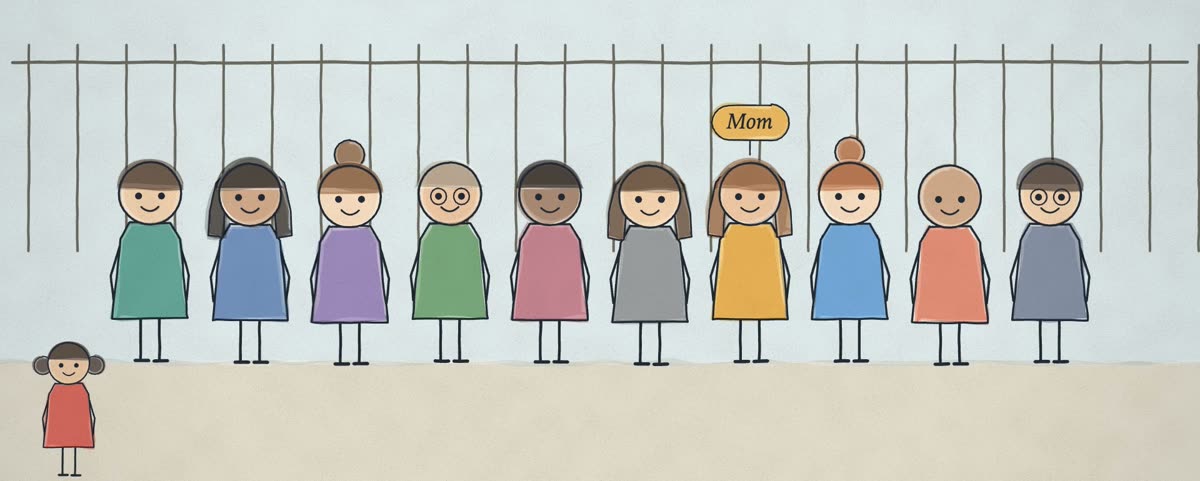
You’re not imagining it, and you’re not the first parent told “she sees fine.” Researchers Chokron and Dutton wrote in 2016 that parents’ reports of real vision problems are sometimes dismissed by professionals “who erroneously equate ‘seeing’ with visual acuity.” Here’s what to do.
Why “she can see” isn’t the question
- An eye chart tests how small a detail your child can see, in a quiet room, one thing at a time. That’s called acuity.
- CVI is about what the brain does with what the eyes send: clutter, crowds, faces, movement, tiredness.
- In one UK study of mainstream primary schools, fewer than 1 in 5 children with CVI-related vision problems had reduced acuity.
- The NIH CVI Working Group says a normal eye exam “does not exclude the presence of CVI.”
- Texas School for the Blind and Visually Impaired notes that “all visual fields are intact” on an eye report may only hold in the quiet, uncluttered eye doctor’s office.
- For school, IDEA asks a different question: does a vision problem, even with correction, hurt how your child does in school?
Why “he did it yesterday” isn’t proof
“My Vision Varies” is one of ten three-word phrases a 2022 expert panel agreed on for CVI (Pilling and colleagues, Eye). US pediatric and eye doctor groups say children with CVI “may experience significant day-to-day variability in visual function.”
Yesterday’s quiet 9 a.m. success says little about today’s 2 p.m. in a loud room. Tiredness, noise, clutter, illness and new places all change what a child with CVI can do. Judge by the hard days, not the best one. More: CVI fatigue, good days and bad days.
Kids also hide it. CVI Scotland says children with CVI learn “not to talk about their visual experiences, because they have not been believed.”
Step by step
Put it in writing
Email the principal or special education director. Ask for an evaluation that includes a functional vision assessment by a teacher of the visually impaired (TVI). Copy a letter.
Show what you see
Keep a two-week log: time, place, task, what happened. Add short videos and a doctor’s letter if you have one.
Bring the federal memo
Print OSEP 17-05. What it says, in plain words.
Get the TVI to the meeting
Use the meeting checklist.
Get every no in writing
This is called prior written notice: what the school won’t do, and why.
Disagree with their testing?
Ask for an independent educational evaluation (IEE), done by someone outside the school, at public expense.
Get free help
Every state has a federally funded Parent Training and Information Center. Find yours at parentcenterhub.org/find-your-center/.
What to say
“I understand her eye exam was normal. CVI is a vision problem in the brain, and a normal eye exam doesn’t rule it out. I’m asking for a functional vision assessment by a teacher of the visually impaired, in class, in the hallway and in the afternoon.”
“Experts have a phrase for CVI: ‘My vision varies.’ What he did yesterday in a quiet room doesn’t tell us what he can do today in a loud one. Can we plan for his hardest times, not his best?”
“Can I have that decision, and the reasons for it, in writing?”
What to ask for in writing
- A functional vision assessment by a TVI that covers CVI
- Observations in more than one place and at different times of day
- A learning media assessment (how your child reads and learns best)
- An orientation and mobility evaluation
- The name of the person doing each one
- Copies of every report before the meeting
- Prior written notice for anything refused
Next step
Learn what a functional vision assessment should cover. Want help with wording? Paste the school’s email into the free parent helper for a draft reply.
Watch the film
The CVI scale: can see, still struggles is a three-and-a-half-minute film about kids near the top of the scale. Send it to anyone who says “but he did it yesterday.”
Common questions
- The school doesn't believe my child has CVI. What can I do?
- Ask in writing for an evaluation that includes a functional vision assessment by a teacher of the visually impaired. If they refuse, ask for the decision and the reasons in writing, and call your state's free Parent Training and Information Center.
- Does my child need a CVI diagnosis to get vision services at school?
- Rules vary by state. Under IDEA, the question is whether a vision problem affects learning, and a 2017 federal memo says no single test can decide that. A doctor's letter always helps, so get one if you can.
- Why does my child do fine some days and not others?
- Vision in CVI often changes with tiredness, noise, clutter, illness and new places. US pediatric and eye doctor groups describe 'significant day-to-day variability' in children with CVI.
Sources (11)
- US Department of Education, OSEP Memo 17-05 on eligibility for visual impairment (2017)
- Chang, Merabet and others, NIH CVI Working Group definition, Ophthalmology (2024)
- Chokron and Dutton, Impact of cerebral visual impairments on motor skills, Frontiers in Psychology (2016)
- Williams and others, CVI-related vision problems in primary school children (2021)
- Texas School for the Blind and Visually Impaired, Why do students with CVI continue to need services from the TVI?
- Pilling and others, Make it easier, 3-word strategies for CVI, Eye (2022)
- American Academy of Pediatrics and others, CVI clinical report (2024), via PCVIS
- CVI Scotland, Yellowstone blog 39, Keeping it to myself (2025)
- 34 CFR 300.503, Prior notice by the public agency
- 34 CFR 300.502, Independent educational evaluation
- Center for Parent Information and Resources, Find your Parent Center
From cviexplained.com/school-says-child-can-see/. General information for families and school staff. Not medical or legal advice. CVI is different for every child.