Something is off: signs it could be CVI
If your child has vision problems that an eye exam cannot explain, or that glasses do not fix, ask the doctor whether it could be CVI. CVI is a brain-based visual impairment, so the eyes can look healthy. It is worth asking most of all if your child was born early or has had a brain injury.
You are not imagining it
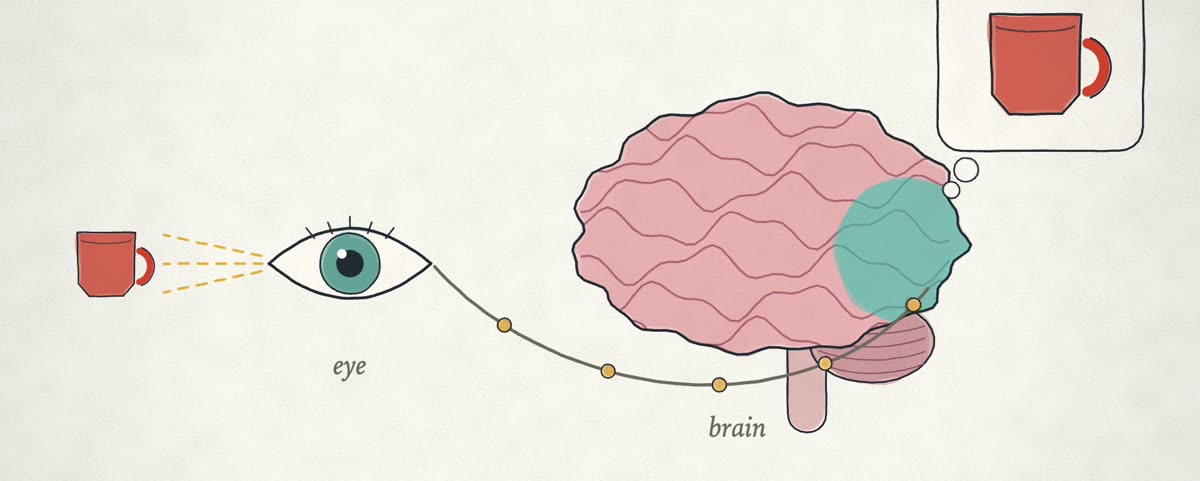
Many parents of children with CVI were first told “her eyes are fine”. Both things can be true. The eyes can be healthy, and the child can still have real trouble seeing, because seeing happens in the brain.
A normal eye exam does not rule out CVI
In 2024, a team of experts brought together by the National Institutes of Health (NIH) wrote a working definition of CVI. It says that “normal performance on the standard ophthalmic clinical examination does not exclude the presence of CVI.”
In plain words: your child can read the eye chart and still have CVI. In older kids especially, the main trouble may be making sense of what they see, not seeing small print. One UK study of primary schools found that fewer than one in five children with CVI-related vision problems had reduced acuity (sharpness on the eye chart).
If your child passes the eye chart but still struggles, read my child can see, so why do they struggle? and mild CVI.
Signs to write down
The National Eye Institute says children with CVI may have trouble:
- responding to the things they see
- seeing parts of what is in front of them, like busy moving scenes
- recognizing faces and objects
- recognizing things in cluttered spaces
- reaching for something while they are looking at it
- understanding what they are looking at
Parents may also notice that the child:
- reacts slowly to things they see
- prefers to look at things that are moving
- looks with one part of their vision, such as from the side
- stares at lights, or is bothered by light
You may also see everyday versions of these: tripping on curbs and steps, walking past you in a crowd, not finding a toy on a patterned rug, or seeing something one day and not the next.
A checklist of everyday signs
Tick what you’ve seen. No single sign means CVI, and many children without CVI do some of these. A pattern is worth taking to the doctor.
- Finds a toy on a plain surface, but not in a toy box or on a busy rug
- Can’t find one piece of clothing in a pile
- Walks past you in a crowd, or finds you only when you speak
- Has trouble recognizing familiar faces, or people in photos
- Takes a few seconds to notice something you hold up
- Notices things more when they move
- Looks away, or to the side, when reaching for something
- Stares at lights, or is bothered by bright light
- Sees better up close than far away
- Trips on curbs, steps or things on the floor
- Does fine in a quiet room, but struggles in busy, noisy places
- Sees something one day and not the next, or does worse when tired
These are drawn from the National Eye Institute, the American Academy of Pediatrics 2024 report on CVI, the American Association for Pediatric Ophthalmology and Strabismus, and Perkins School for the Blind. Take your ticked list to the doctor visit.
Longer question lists exist too. Doctors and researchers use parent questionnaires to spot CVI, and the NIH definition says they’re most useful for children with good eye chart results. Perkins School for the Blind keeps a list of CVI screening tools and questionnaires. It includes the Flemish CVI Questionnaire and the question inventories developed by Gordon Dutton and his team. Perkins notes that a screening alone does not provide a diagnosis.
What to do this week
- Keep a list. Write down what you see, where, and at what time of day. Short notes are enough.
- Take a video. Thirty seconds of your child searching for something says more than a description.
- Ask the question out loud. “Could this be CVI, cerebral visual impairment?” Not every doctor knows CVI well, so name it.
- Ask for the right referral. An eye doctor familiar with CVI, and possibly a pediatric neurologist or neuro-ophthalmologist.
- Do not wait to change the space. Clearing clutter and giving extra time help whether or not there is a diagnosis yet.
Who is more likely to have CVI
The National Eye Institute says CVI is caused by an injury to the brain, most often before, during or shortly after birth, and that babies born early are more likely to have it. Children with CVI often have other conditions too, such as cerebral palsy, epilepsy or developmental disabilities.
A child with none of these can still have CVI.
Common questions
- The eye doctor said my child's eyes are fine. Can it still be CVI?
- Yes. CVI starts in the brain, so an eye exam can be normal. The National Eye Institute says that when an exam does not find eye problems that explain the symptoms, the problem might be with the brain, and the child should see an eye doctor who is familiar with CVI.
- Which doctor diagnoses CVI?
- Start with your pediatrician and ask for an eye doctor who is familiar with CVI. The National Eye Institute says a child may also need a pediatric neurologist or a neuro-ophthalmologist. There is no single test for CVI.
- Could it be autism or ADHD instead?
- CVI can be mistaken for other conditions. Perkins School for the Blind lists ADHD, autism, delayed visual maturation and learning disabilities as common misdiagnoses. A child can also have CVI together with one of these. Only a clinician can sort that out, so describe exactly what you see.
- How common is it for CVI to be missed?
- Very common. Perkins School for the Blind estimates that fewer than 20 percent of likely cases in the United States are diagnosed. That figure is an estimate from insurance data, not a census.
Sources (9)
- National Eye Institute, Cerebral Visual Impairment (CVI)
- Perkins School for the Blind, What is CVI?
- Perkins School for the Blind, CVI by the numbers
- Chang, Merabet and the CVI Working Group, Cerebral/cortical Visual Impairment (CVI) Working Definition, a report from the NIH CVI Workshop (Ophthalmology, 2024)
- Williams and others, Cerebral visual impairment-related vision problems in primary school children (Developmental Medicine and Child Neurology, 2021)
- American Academy of Pediatrics, Cerebral/Cortical Visual Impairment clinical report (Lehman, Yin, Chang and others, Pediatrics, 2024), PDF hosted by PCVIS
- Perkins School for the Blind, CVI screening tools and questionnaires you should know about
- American Association for Pediatric Ophthalmology and Strabismus, Cerebral Visual Impairment
- Perkins School for the Blind, CVI and visual guidance of the lower limbs
From cviexplained.com/signs/. General information for families and school staff. Not medical or legal advice. CVI is different for every child.