My child can see. Why do they still struggle?
An eye exam checks how small a detail your child can see. It doesn't check how the brain handles a busy page, a crowd, a face or a flight of stairs. CVI (cerebral visual impairment) is one possible reason a child who 'can see' still struggles, but it isn't the only one, so write down what you see and ask an eye doctor who knows CVI.
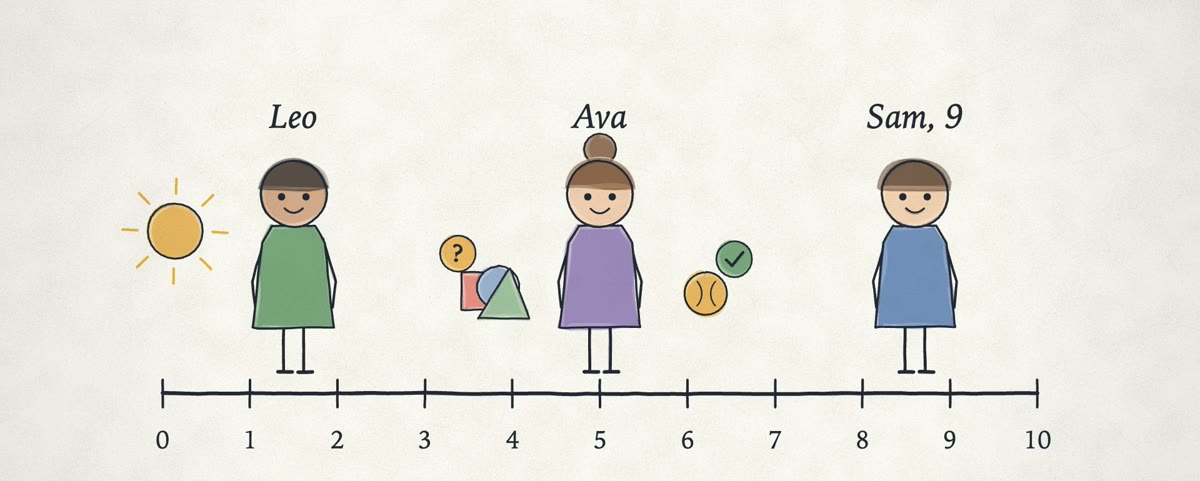
Does this sound like your kid?
Tick what you’ve seen. Each one has its own page.
- Skips lines or loses their place when reading. See reading.
- Knows the math out loud, falls apart on the worksheet. See math.
- Messy writing, can’t copy from the board. See handwriting.
- Can’t find the thing that’s right in front of them. See finding things.
- Bumps into things, trips, hates stairs. See bumping and tripping.
- Walks past you at pickup, misses a friend’s wave. See faces.
- Wiped out after school. Did it yesterday, can’t today. See tiredness.
- Falls apart in stores, parties or the cafeteria. See meltdowns.
If you ticked a few, read the mild CVI signs checklist next.
Why the eye exam can miss it
Most eye exams measure acuity: how small a letter your child can read on a chart. That’s what “20/20” means. It doesn’t test how the brain sorts what the eyes send.
CVI is a vision problem that starts in the brain, not the eyes. The eyes can be healthy.
- An NIH expert group says a normal standard eye exam “does not exclude the presence of CVI.”
- In one UK study of ordinary primary schools, about 3 in 100 children had at least one CVI-related vision problem. Fewer than 1 in 5 of those children had reduced acuity.
- A 2025 US study found that kids with milder CVI were diagnosed later than kids with severe CVI, some years later.
CVI is one possible reason, not the only one
We can’t tell you what’s going on with your child. Nobody can from a web page. These struggles can also come from:
- an eye problem the screening didn’t catch
- ADHD, autism or dyslexia
- coordination problems, anxiety, poor sleep
A child can have CVI and one of these. Perkins School for the Blind says CVI is often mistaken for ADHD, autism or learning disabilities. To sort out the overlap, read CVI or ADHD, CVI or autism, CVI or dyslexia and CVI or visual processing disorder.
If a clinic offers eye exercises (“vision therapy”) for these problems, ask your pediatrician first. The pediatric eye doctors’ group says behavioral vision therapy hasn’t been proven by science to work.
What to try this week
Write it down
One line each time. What happened, where, what time, how tired. Two weeks of notes beats any description.
Film it
Thirty seconds of your child hunting for a shoe on a messy floor says a lot.
Change one thing and watch
Copy one math problem onto a blank page. Read in a quiet room. Clear the floor by the stairs. If it helps, note that too.
Ask the question out loud
Not every doctor thinks of CVI, so name it.
“My child passed the eye exam, but [skips lines / trips on stairs / can’t find things on a busy table]. Could this be CVI, cerebral visual impairment? Who can check for it?”
Who to ask
- Your pediatrician. Ask for a referral to an eye doctor who knows CVI, often a pediatric ophthalmologist or neuro-ophthalmologist. See the doctor visit.
- The school. Ask for a teacher of the visually impaired (TVI) to observe your child. Read the school says my child can see and functional vision assessment.
- Your state’s Parent Training and Information Center. Free help with school questions. Find yours.
Already have a diagnosis and a score? Read the CVI Range and Phase III CVI.
Watch the film
The CVI scale: can see, still struggles is a three-and-a-half-minute film about kids near the top of the scale. Send it to anyone who says “but he did it yesterday.”
Common questions
- My child passed the school vision screening, so why are they still struggling?
- A screening checks eyesight, mostly how small a letter your child can read. A 2024 report from US pediatric and eye doctor groups says routine screening may not pick up brain-based vision problems like CVI. Other things can cause these struggles too, so take notes and ask your doctor.
- What is high functioning CVI?
- It isn't a medical term. Parents and teachers use it for a child with CVI who reads, talks and gets around, but still struggles with clutter, crowds, faces, stairs or tiredness. These kids are often diagnosed late.
- Should I try vision therapy?
- In the US, vision therapy usually means eye exercises at an optometrist's office. The American Association for Pediatric Ophthalmology and Strabismus says behavioral vision therapy has not been proven by science to work. Kids with CVI are usually helped by a teacher of the visually impaired and an orientation and mobility specialist, through school.
Sources (9)
- Chang, Merabet et al., CVI Working Definition, NIH CVI Workshop (Ophthalmology, 2024)
- AAP, AAPOS, AAO and AAC, Diagnosis and Care of Children With Cerebral/Cortical Visual Impairment (2024)
- Williams et al., CVI-related vision problems in primary school children (Developmental Medicine & Child Neurology, 2021)
- Rice et al., delayed diagnosis of CVI (Ophthalmic & Physiological Optics, 2025)
- Perkins School for the Blind, CVI by the numbers
- Perkins School for the Blind, What is CVI?
- American Association for Pediatric Ophthalmology and Strabismus, Vision Therapy
- National Eye Institute, Cerebral Visual Impairment (CVI)
- Center for Parent Information and Resources, Find Your Parent Center
From cviexplained.com/can-see-but-struggles/. General information for families and school staff. Not medical or legal advice. CVI is different for every child.