When your child doesn't recognize faces
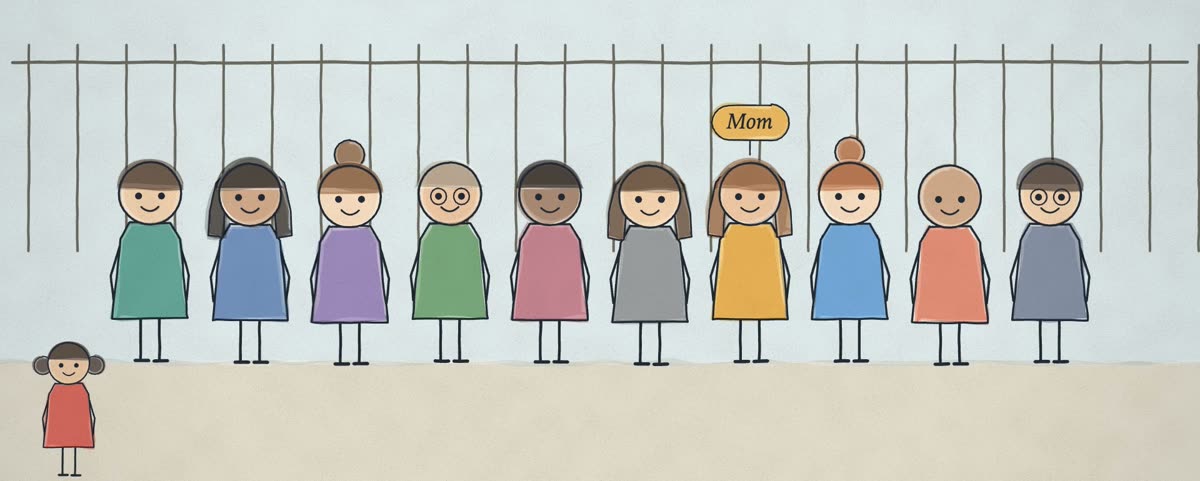
Some children with CVI find faces hard to recognize or read, even when they see well enough to read a book. They may walk past you at pickup, miss a friend's wave, or seem rude. Say your name when you walk up, tell them who is where, and don't ask for eye contact.
What it can look like
- Walks past you at pickup, then lights up when you speak.
- Misses a friend waving across the playground.
- Knows people by voice, hair, glasses or coat.
- Gets confused when you change your hair or wear a new jacket.
- Doesn’t look at you while you talk.
- Misreads a joke, a frown or a “stop” look.
- Plays alone, or sticks to one friend.
- Gets called rude or stuck-up for not saying hi.
Why faces are hard
Faces are one of the busiest things we look at. They move, they change, and they all have the same parts.
Perkins School for the Blind says some people with CVI find it hard to look at faces, recognize them, read expressions and body language, or tell who is coming toward them. A Texas vision-teacher guide makes a key point: eye contact doesn’t mean a child can tell faces apart.
Many kids find their own ways around it, using voice, footsteps, hair, clothes, shoes, glasses, height or the way someone walks.
Trouble with faces can come from other things too, like autism or prosopagnosia (face blindness) on its own. A child can have more than one. See CVI or autism.
What helps
- Say your name, every time. Perkins gives this kind of example: “Hi Harry, it’s Mr. Sean, I’m walking toward you on your right side.”
- Say how you’re connected. For people your child sees less often: “It’s Aunt Jo. We had pizza at my house.”
- Point out what to look for. “Grandma’s the one in the red coat.”
- Say who’s in the room. “Dad’s on the couch. Your cousins are by the door.”
- Pick a meeting spot. Same place every pickup, same bright hat on you.
- Put feelings into words. “She’s laughing, she’s happy.” Perkins suggests this, because faces may not show it.
- Don’t ask for eye contact. Looking and listening at once can be very hard.
A card for family and friends
[Name] has CVI. Their eyes work, but their brain has a hard time with faces, especially in a crowd. If they walk past you or don’t wave back, they didn’t see it was you. Please:
- Say your name first: “Hi [name], it’s Uncle Dave.”
- Tell them where you are: “I’m by the front door.”
- Don’t ask them to look at you. They’re listening.
- Don’t quiz them with “Who am I?”
More ways to explain it: explaining CVI to family.
At school
Perkins says trouble recognizing people can cause social anxiety and hurt self-esteem. Ask the teacher to:
- say their name when they talk to your child
- tell your child where friends are: “Maya is by the red bench”
- with your child’s OK, ask classmates to say their names
- not test your child’s vision in front of the class
The classroom page has more: classroom checklist. For getting the school on board, read the school says my child can see.
Common questions
- Why doesn't my child recognize me?
- If your child knows your voice but walks past you in a crowd, faces may be hard for their brain to sort. This can happen with CVI. It doesn't mean they don't know you or love you.
- Why can't my child recognize faces?
- There are several possible reasons. CVI is one. Others include autism and a separate condition called prosopagnosia, or face blindness. Write down what you see and ask your doctor.
- Should I make my child look at me when I talk?
- No. Perkins School for the Blind says a person with CVI shouldn't be expected to look at you while you talk, because looking and listening at once can be very hard.
Sources (5)
- Perkins School for the Blind, CVI Access to People
- Perkins School for the Blind, CVI and the ECC: Social Interaction Skills
- Texas School for the Blind and Visually Impaired, Why do students with CVI continue to need services from the TVI?
- CVI Scotland, School Support Guide
- National Eye Institute, Cerebral Visual Impairment (CVI)
From cviexplained.com/cvi-faces/. General information for families and school staff. Not medical or legal advice. CVI is different for every child.