CVI IEP goal ideas for each phase
A good IEP goal says what your child will do, under what conditions, how well, and how it's measured, and it comes from your child's own assessment. Early phases often focus on looking and using vision in daily routines. Phase III goals often cover reading with adapted materials, getting around, social skills and speaking up for their needs.
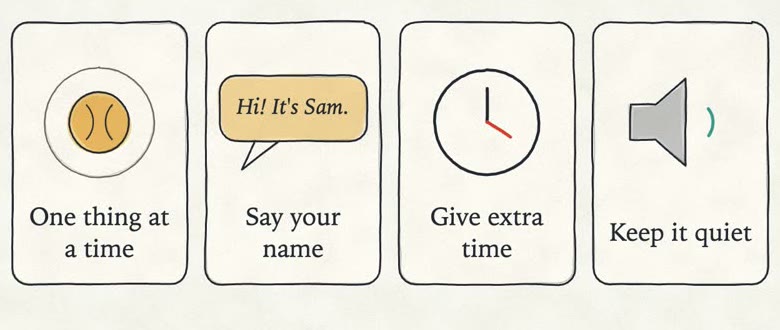
These are example ideas to bring to your team. They aren’t legal advice or a goal bank. Rules and forms vary by state. Fill every [bracket] from your child’s assessment, not from this page.
Read this first
- Goals should come from your child’s present levels and their CVI assessment by a teacher of the visually impaired (TVI).
- A goal says what your child will do. “Will get 30 minutes of vision services” is a service, not a goal.
- Perkins says vision access should be part of every goal, not left to the TVI alone. Reading and math goals need it too.
- You can ask how a goal was chosen and for the data behind it.
What a good goal has
The setup
What’s provided: the materials, the room, the supports.
The skill
What your child will do, in words anyone could check.
How well
For example, 4 out of 5 tries.
How it’s measured
Who checks, how often and for how long.
Phase I (about 0 to 3)
Goal areas: looking at familiar objects, looking during daily routines, building steady visual attention.
- “Given a familiar object in [favorite color] on a plain black background in a quiet room, [child] will look at it within [number] seconds in [4 of 5] chances across [3] sessions, as recorded by the TVI.”
- “At snack time, when shown their [color] cup on a plain tray, [child] will look toward it before it’s handed over in [4 of 5] chances.”
Phase II (about 3 to 7)
Goal areas: using looking to choose or act, recognizing familiar objects and then photos, finding marked items in routines.
- “Given two photos of familiar objects on a lit tablet with a plain background, [child] will touch the one named in [4 of 5] trials across [3] weeks.”
- “During arrival, [child] will find their [color-marked] cubby among [number] cubbies in [4 of 5] days.”
- “When shown a new object and told its two or three key visual features, [child] will point out one feature in [4 of 5] chances.”
Phase III (about 7 to 10)
Perkins lists goal areas for students with CVI such as reading, writing, math, communication, self-advocacy, self-regulation, organization, independent travel and social skills. The examples below are ours.
- Speaking up: “When given a worksheet that isn’t adapted, [child] will ask for an accessible version in [4 of 5] chances.”
- Getting around: “Using landmarks chosen with the orientation and mobility specialist, [child] will walk from [room] to [room] during class change in [4 of 5] trials.”
- People: “[Child] will use voice, clothing or other non-face clues to name a classmate who approaches in [4 of 5] chances.”
- Devices: “[Child] will set up zoom and contrast on their device without help in [4 of 5] sessions.”
- Tiredness: “[Child] will notice signs of visual fatigue and ask for a break or a switch to audio in [4 of 5] observed chances.”
Red flags
- The goal says “will improve visual skills” with no skill or number.
- Data is only taken in a quiet room in the morning.
- Reading and math goals don’t say what adaptations are used.
- TVI time is cut because your child reached Phase III. Experts warn this often happens and say services should continue.
“How did you choose this goal, and what data supports it?”
“Where is vision access built into the reading and math goals?”
Next: pick supports from Supports to ask for at school, and see School plans in plain English.
Common questions
- Where can I find a CVI IEP goal bank?
- Many goal banks cost money, and none know your child. Use the examples here as starting points, and ask the TVI to fill the blanks from the assessment.
- What are good IEP goals for Phase 3 CVI?
- Common areas are reading and math with adapted materials, travel with an orientation and mobility specialist, social skills, using a device, noticing tiredness, and asking for what they need. Vision access should show up in every goal, not just the vision goal.
- Should my child with CVI have an IEP or a 504 plan?
- A 504 plan lists changes to how your child accesses school, and usually has no goals. If your child needs teaching from a TVI or an orientation and mobility specialist, ask about an IEP.
Sources (7)
- Perkins School for the Blind, How to design IEP goals and objectives for kids with CVI
- Perkins School for the Blind, Getting started with CVI assessments
- Perkins School for the Blind, Examining degree of impact and CVI phases
- Pediatric Cortical Visual Impairment Society, Phase I CVI
- Pediatric Cortical Visual Impairment Society, Phase II CVI
- Pediatric Cortical Visual Impairment Society, Phase III CVI
- Texas School for the Blind and Visually Impaired, TX SenseAbilities, Fall 2017 (Phase III CVI)
From cviexplained.com/cvi-iep-goals-by-phase/. General information for families and school staff. Not medical or legal advice. CVI is different for every child.