How to read your child's CVI assessment report
Most CVI reports either give a CVI Range score from 0 to 10 with a phase, or describe your child with the 16 visual behaviors from the Perkins CVI Protocol. Either way, the report shows how your child uses vision right now. It does not diagnose CVI and it is not a verdict. Ask what each finding means on a normal school day, which supports go with it, and when it will be checked again.
You got a report full of numbers and terms, and a meeting is coming. Here’s how to read it.
What this report is, and isn’t
- It describes how your child uses vision day to day. That’s called functional vision.
- It is not an eye exam. It doesn’t measure how sharp the eyes are.
- It doesn’t diagnose CVI. A doctor does that.
- It’s a snapshot. Scores can change over time.
If it says “CVI Range”
The CVI Range is a tool made by Dr. Christine Roman-Lantzy. It’s usually done by a teacher of the visually impaired (TVI). It mixes a talk with you, watching your child, and direct testing.
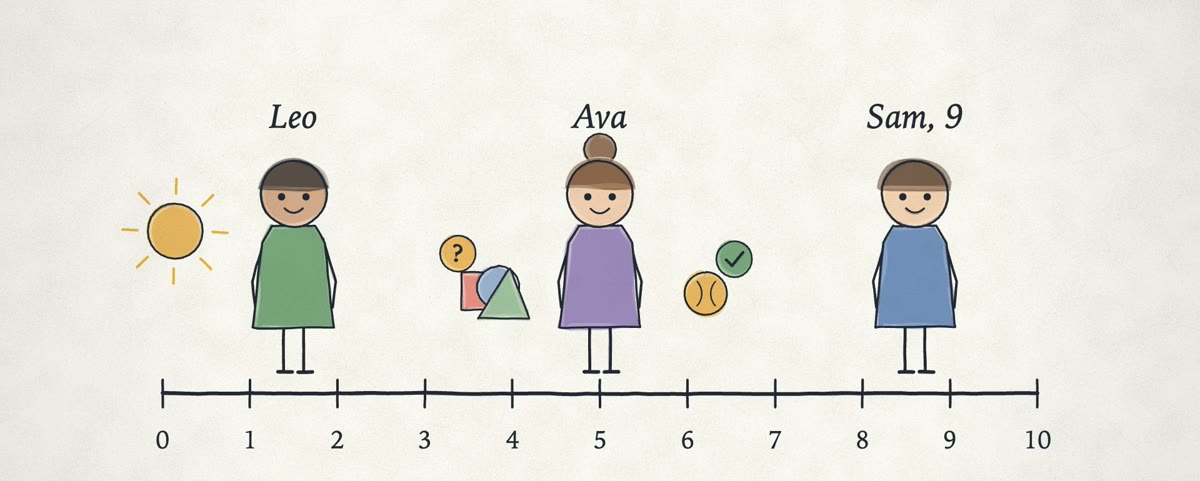
- The score runs from 0 to 10. Near 0 means little or no use of vision. Higher means looking that’s closer to typical.
- 10 almost never happens. Its author says she has never given a 10. CVI doesn’t go away.
- There are often two ratings. They’re reported together, sometimes as a pair like “3-4.”
- The score falls in a phase: about 0 to 3 is Phase I, about 3 to 7 is Phase II, about 7 to 10 is Phase III. Sources draw the edges a little differently. See CVI phases.
- It’s built on 10 characteristics, like color, light and busy scenes. See the 10 characteristics in everyday words.
If it says “Perkins CVI Protocol”
This is a free tool from Perkins School for the Blind. It’s meant for a TVI to use.
- It gives no phase and no single score.
- It describes 16 visual behaviors, like clutter, faces, light and getting around.
- It also looks at compensatory skills: the tricks your child uses to get by, like knowing people by their voice.
What a good report includes
- Which tool was used, who did it, and the date.
- What you told them about home.
- Your child’s own view, if they can give it.
- Watching in more than one place and time of day. A quiet room at 9 a.m. is your child’s best case.
- Clear findings in plain words.
- Supports tied to each finding, with numbers where they matter: font size, wait time, items per page.
- Other assessments it links to, like a learning media assessment (how your child reads best: print, audio, braille) or orientation and mobility (getting around safely).
Questions to ask
“Which tool did you use, and why that one?”
“Where and when did you watch [child]? Did you see the cafeteria, the hallway at class change, or the afternoon?”
“What does this score mean for [child] on a normal Tuesday?”
“Which supports go with each finding? Can we put the score and phase in the IEP?”
“When will you check again? Can the same person do it?”
That last one matters. In one 2026 study, the average one-year change in score was smaller than the gap between two testers scoring the same child.
If the score is high
A high score does not mean your child’s vision is fine. Children in Phase III still have CVI. Busy scenes, faces, distance, new places and tiredness can still get in the way.
Experts warn that vision teacher time is often cut for these kids. One Texas School for the Blind article says it should be kept, not reduced.
Some kids who pass the eye chart aren’t well described by the CVI Range at all. Other tools, like question lists and the Perkins Protocol, may fit them better.
Next: Phase III CVI and What to do when the school says your child can see.
Common questions
- Where can I find the CVI Range scoring guide?
- It's printed in Dr. Christine Roman-Lantzy's book, which APH Press sells. It's copyrighted, so we don't copy it here. Ask your child's TVI to walk you through how they reached the score.
- Is there a free CVI assessment?
- The Perkins CVI Protocol is free to download. It's meant to be done by a teacher of the visually impaired (TVI), for students aged 0 to 22 who have CVI or might have it.
- Does the CVI Range diagnose CVI?
- No. Its author says diagnosing CVI from the Range is improper. A doctor diagnoses CVI. The Range describes how a child uses vision.
Sources (9)
- Christine Roman-Lantzy, The CVI Range (history and purpose)
- Christine Roman-Lantzy, The CVI Range assessment
- Christine Roman-Lantzy, The rationale behind the CVI Range Endorsement
- APH Press, Cortical Visual Impairment, An Approach to Assessment and Intervention (2nd edition)
- Pediatric Cortical Visual Impairment Society, Phase III CVI
- Perkins School for the Blind, Getting started with CVI assessments
- Perkins School for the Blind, The Perkins CVI Protocol
- Texas School for the Blind and Visually Impaired, TX SenseAbilities, Fall 2017 (Phase III CVI)
- Chang et al., Validity and Reliability of the CVI Range for Clinical Research (Ophthalmology Science, 2026)
From cviexplained.com/cvi-range-report/. General information for families and school staff. Not medical or legal advice. CVI is different for every child.